
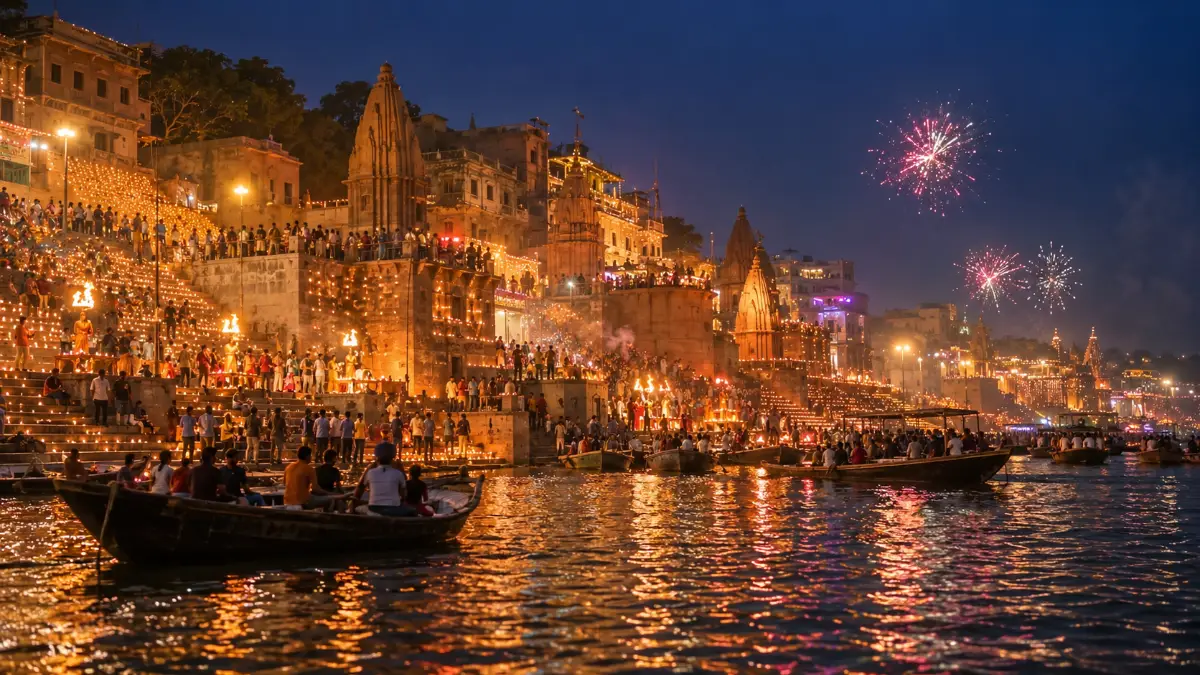
Dev Deepawali 2026 in Varanasi: When Kashi Becomes a City of Light
Imagine sitting quietly on the River Ganga as evening falls over Varanasi. The sky slowly turns dark, temple bells begin to ring, chants drift across the water and one diya after another starts glowing along the ancient stone steps.
Within a short time, the riverfront seems transformed.
This is Dev Deepawali in Varanasi, one of the most beautiful and spiritually significant celebrations associated with Kashi.
Celebrated on Kartik Purnima, around fifteen days after Diwali, Dev Deepawali is often called the “Diwali of the Gods.” According to Hindu belief, the gods descend to Earth on this sacred occasion to bathe in the Ganga and bless the holy city of Kashi.
In 2026, Dev Deepawali will be celebrated on Tuesday, 24 November in Varanasi.
But Dev Deepawali is much more than a spectacular night of lamps. Its story is connected with Lord Shiva, its rituals with the sacred Ganga, and its identity with centuries of faith and tradition in Varanasi.
Why Is Dev Deepawali Celebrated?
One of the most important stories behind Dev Deepawali is associated with Lord Shiva's victory over Tripurasura.
According to Hindu tradition, three powerful demon brothers were associated with three fortified cities collectively called Tripura. As their power grew and disorder spread, the gods sought Lord Shiva's help.
Lord Shiva eventually destroyed Tripura, restoring order. Because of this victory, Shiva is also associated with the name Tripurari, meaning the destroyer of Tripura.
The gods are believed to have celebrated Shiva's victory by illuminating Kashi with lamps. The occasion therefore came to be associated with Tripura Purnima, Tripurari Purnima and Dev Deepawali.
Symbolically, the festival represents the victory of light over darkness and righteousness over evil.
Dev Deepawali vs Diwali: Are They the Same?
No.
Although both celebrations involve diyas, Diwali and Dev Deepawali are different festivals.
Diwali is celebrated on Amavasya, while Dev Deepawali takes place on Kartik Purnima, the full-moon night roughly fifteen days later.
Dev Deepawali has a particularly strong association with Varanasi, the Ganga and Lord Shiva.
That is why visitors who have already experienced Diwali may still find Dev Deepawali in Kashi completely different.
The focus shifts from homes and neighbourhoods to the river, temples and ghats.
What Happens in Varanasi During Dev Deepawali?
As sunset approaches, people begin placing and lighting earthen lamps across the riverfront.
The ancient ghats gradually glow under countless flames while their reflections shimmer across the Ganga.
Official tourism information describes the festival as including illuminated ghats, sacred rituals, Ganga Aarti, devotional music and cultural performances throughout the city.
From a boat, the illuminated riverfront can appear almost continuous.
From the ghats, the experience is very different: temple bells, chants, the smell of incense, crowds of devotees and thousands of individual diyas create an atmosphere that photographs alone rarely capture.
Ganga Aarti During Dev Deepawali
The evening Ganga Aarti is one of Varanasi's best-known spiritual experiences throughout the year.
During Dev Deepawali, its surroundings become especially striking.
Priests perform the traditional ceremony using lamps, incense and rhythmic movements accompanied by bells and devotional chants. The glow of the ceremony merges with countless diyas already illuminating the ghats.
Ganga Aarti forms an important part of the Dev Deepawali experience described by official tourism sources.
Even for visitors who have previously watched the regular evening Aarti, witnessing it during Dev Deepawali can feel completely different because of the scale of the celebration around it.
Best Ghats to Experience Dev Deepawali
There isn't necessarily one single “best” viewpoint because each part of the riverfront creates a different experience.
Some of the names visitors commonly encounter while exploring the Varanasi ghats include:
Dashashwamedh Ghat
Assi Ghat
Rajendra Prasad Ghat
Panchganga Ghat
Raj Ghat
The celebration extends across the riverfront rather than being restricted to one location. Incredible India's description notes illumination stretching from Assi Ghat towards Raj Ghat.
A boat ride can therefore be particularly useful for travellers hoping to see a broader panorama of Kashi.
Dev Deepawali Is More Than a Festival of Lights
It is easy to describe Dev Deepawali using numbers—the lamps, visitors, boats and ghats.
But numbers do not explain why the festival remains so special.
The real experience lies in smaller moments.
A family lighting a diya together.
Someone quietly offering a lamp to the Ganga.
A priest preparing for Aarti.
A boatman navigating through the evening river.
The sound of bells reaching across the water.
The moon appearing over the ancient skyline of Kashi.
Dev Deepawali brings all these moments together.
It is simultaneously a religious observance, a community celebration and a remarkable expression of Varanasi's living heritage.
Best Time to Visit Varanasi
October to March is generally considered a pleasant period for exploring Varanasi, particularly for walking through the old city, visiting the ghats and taking boat rides.
A Dev Deepawali journey can also be combined with other experiences such as:
Kashi Vishwanath Temple
Morning boat ride on the Ganga
Ganga Aarti
Old Varanasi walking tour
Banarasi silk shopping
Local Banarasi food
Sarnath
This turns a one-evening festival visit into a deeper experience of Varanasi.
Why You Should Experience Dev Deepawali at Least Once
Some festivals are best understood by reading about them.
Dev Deepawali is better understood by standing beside the Ganga and watching the first few diyas being lit.
Slowly, one lamp becomes hundreds.
Hundreds become thousands.
The water begins reflecting their light, chants rise from the ghats and the ancient city changes before your eyes.
Whether you visit for spirituality, photography, culture, history or simply curiosity, Dev Deepawali in Varanasi offers something difficult to reproduce anywhere else.
And perhaps that is the real magic of the festival.
It isn't only about seeing Kashi illuminated.
It is about experiencing Kashi when faith, history, people, river and light all become part of the same story.